
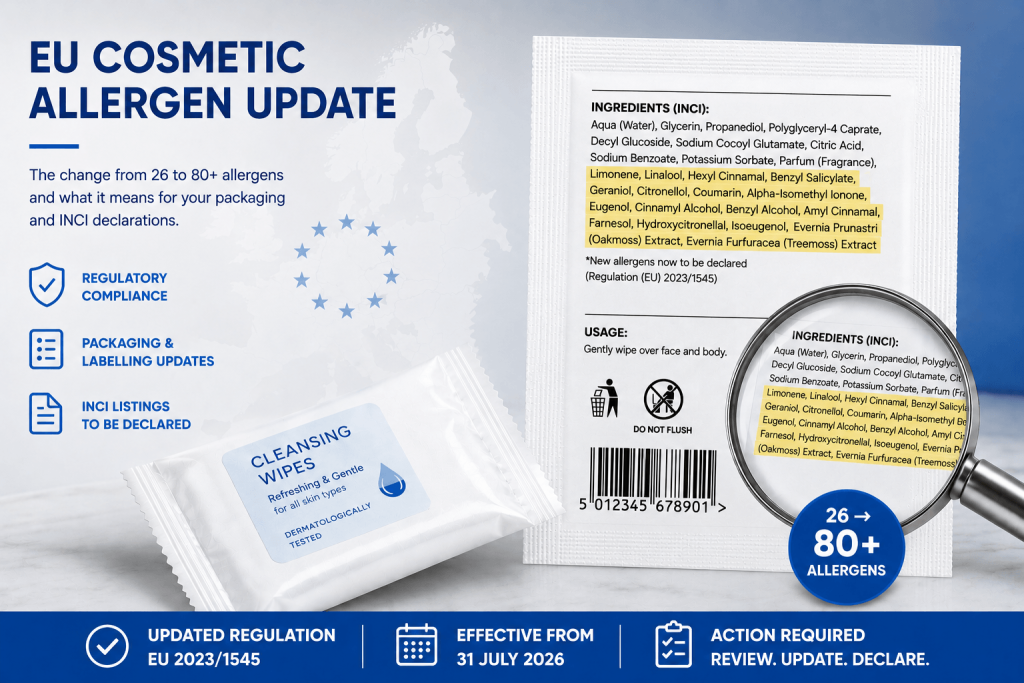
From 31st July 2026, significant changes to EU cosmetic allergen labelling come into force that will affect every cosmetic brand placing new products on the European market. While the update focuses on improving transparency for consumers with fragrance allergies, it also places greater responsibility on manufacturers, suppliers and brand owners to ensure their product labelling is fully compliant from day one.
Unlike some regulatory changes, there is no grace period for newly placed products. Any cosmetic products entering the EU market from 31 July 2026 must comply with the updated fragrance allergen labelling requirements. Products already placed on the market before this date can continue to be sold until 31 July 2028, after which any non-compliant products must be withdrawn from sale.
This second deadline is just as significant as the first. While new products placed on the EU market after 31 July 2026 must comply immediately, the 2028 deadline gives businesses time to review existing stock, legacy formulations and packaging already in circulation. For many brands, this means planning shouldn’t stop with new product launches – it should extend across their wider product portfolio.
What Is Changing In EU Cosmetic Allergen Labelling?
The EU has updated its cosmetic labelling requirements to give consumers with fragrance allergies clearer information about the ingredients in the products they use. Previously, cosmetic products only needed to declare 24 specified fragrance allergens individually on the ingredient list when they exceeded certain concentration thresholds.
Following a review by the Scientific Committee on Consumer Safety (SCCS), the legislation now requires more than 80 fragrance allergens to be declared individually. This includes the original 24 allergens, plus 56 additional substances identified as potential causes of contact allergies.
The updated requirements also broaden the scope beyond traditional fragrance ingredients to include certain oxidation products and naturally derived isolates that may trigger allergic reactions. This means that even products marketed as unscented are not automatically exempt from the legislation if they contain ingredients that fall within the updated allergen requirements.
The declaration thresholds remain unchanged:
- 0.001% in leave-on products, such as creams, lotions and perfumes.
- 0.01% in rinse-off products, including shampoos, body washes and shower gels.
While the thresholds and number of ingredients haven’t changed since our blog on the legislation in January 2025, there is now further clarification surrounding product withdrawal, meaning many cosmetic labels will now need updating.
Why Does This Matter For Cosmetic Brands?
The updated EU cosmetic allergen labelling requirements are designed to improve transparency for consumers while helping those with fragrance allergies make more informed purchasing decisions. For cosmetic brands, however, the implications go much further than simply adding a few extra ingredients to a label.
Businesses placing products on the EU market need to ensure they:
- Review fragrance compositions supplied by ingredient manufacturers.
- Identify whether any newly listed allergens exceed the declaration thresholds.
- Update artwork and ingredient listings where required.
- Ensure all packaging is compliant before products are placed on the EU market after 31 July 2026.
Leaving these changes until the last minute could lead to unnecessary delays, packaging waste and disruption to product launches.
Failing to comply with the updated requirements can have significant consequences. Depending on the circumstances, businesses may be required to withdraw products from the market, carry out product recalls or face enforcement action from the relevant authorities. As market surveillance continues to increase across Europe, ensuring packaging is compliant before products reach consumers is becoming increasingly important.
What About UK Cosmetic Products?
At present, these updated allergen labelling requirements apply to products being placed on the EU market. UK-only cosmetic products are not currently required to adopt the new allergen declarations.
However, regulatory alignment between the UK and EU has often evolved over time, and many industry experts expect similar requirements could be introduced in the UK in the future.
For businesses that already export to Europe, or may wish to in the future, it makes commercial sense to prepare now rather than waiting for further regulatory changes. Future-proofing packaging can help minimise redesign costs, reduce disruption and ensure products remain ready for multiple markets.
Planning Ahead Pays Off
Packaging design often goes through several approval stages involving product development, regulatory teams, marketing departments and print production. Any late changes can create bottlenecks throughout the supply chain.
By reviewing packaging early and taking current regulatory requirements into account, brands can
- Avoid expensive reprints and obsolete packaging stock.
- Reduce the risk of launch delays.
- Maintain uninterrupted supply to customers.
- Demonstrate a commitment to consumer safety and transparency.
Proactive compliance also gives businesses confidence that they’re ready for future regulatory developments, rather than constantly reacting to them. It also provides valuable time to review existing stock, update legacy product lines and ensure packaging remains compliant ahead of the July 2028 transition deadline.
Guardpack: Ahead Of The Legislation
At Guardpack, keeping pace with regulatory developments is part of how we support our customers. Rather than waiting until the legislation became mandatory, we’ve been preparing customers for the new EU cosmetic allergen labelling requirements since July 2024 by including full cosmetic fragrance allergen listings on our cosmetic labels. As a result, many of our customers have been able to introduce compliant packaging gradually, avoiding last-minute design changes and giving themselves more time to prepare for the July 2026 deadline.
For businesses manufacturing wet wipes and liquid-filled sachets, regulatory compliance doesn’t stop with product formulation. Packaging plays an equally important role in ensuring products meet legal requirements before they reach the market.
Working with a manufacturing partner who understands both packaging production and cosmetic regulations helps reduce risk and gives brands greater confidence that every product leaving the production line is correctly labelled.
Your Packaging Partner for Changing Regulations
Keeping up with legislative changes can be challenging, particularly for businesses managing multiple product lines or selling across different markets. One thing is for certain – regulations will continue to evolve and consumer safety and ingredient transparency will always remain key priorities.
This is why choosing the right manufacturing partner is a critical decision. At Guardpack, we work alongside our customers to help them navigate changing regulatory requirements, ensuring packaging and formulation is accurate, compliant and ready for market.
Whether you’re launching a new cosmetic product, updating existing packaging or preparing for future legislative changes, our experienced team can help you stay one step ahead of the curve.
If you need expert advice on EU cosmetic allergen labelling and compliant cosmetic packaging, we’d love to help you out. Get in touch with our friendly team today by filling out our contact form, email us at trade@guardpack.co.uk, or speak to one of the team today on 01245 505807.
We look forward to hearing from you!