
Sustainable sachet packaging is becoming an increasingly important area of innovation as brands and manufacturers look for alternatives to traditional plastic and foil-laminate formats. But developing a more sustainable material is only part of the challenge. It also needs to perform reliably during printing, filling and sealing, while providing the barrier properties needed to protect liquid products.
Guardpack recently took another step in exploring this challenge through its ongoing collaboration with biomaterials innovator Kelpi. Following earlier trials with Kelpi and Mondi, Guardpack carried out a further production run on 14th September 2026, manufacturing and filling liquid sachets using paper coated with Kelpi’s seaweed-derived biomaterial.
Initial Trial to Production Run
The latest work builds on earlier trials that explored whether Kelpi’s seaweed-derived coating could provide the performance required for liquid-filled sachets while working with established manufacturing equipment.
Moving from a successful trial to production is an important stage in assessing a packaging material’s commercial potential. A material may perform well in controlled testing, but manufacturers also need to understand how it behaves when it is printed, formed, filled and sealed as part of a real production process.
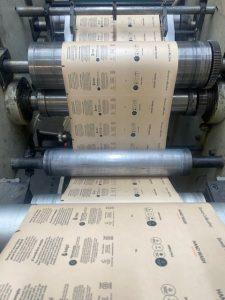
For the latest run, Guardpack printed the coated paper in-house before running it through its existing sachet-filling machinery. Importantly, no equipment modifications were required. The material printed well and successfully formed a seal, demonstrating the potential for the Kelpi-coated paper to work on established sachet production lines rather than requiring bespoke machinery.
Sealing Parameters
One of the key learnings from the production run was the importance of carefully balancing temperature and sealing time. When producing liquid-filled sachets, the seal needs to be strong and consistent without exposing the packaging material to excessive heat or sealing for too long. Too much heat or time can cause issues with the material, while insufficient temperature or sealing time may prevent an effective seal from forming.
Parameters established during Guardpack’s earlier trial provided a useful starting point for the latest production run. This demonstrates an important part of sustainable sachet packaging development: the transition from trial to production is not simply about proving that a material can work, but establishing the manufacturing parameters needed to achieve consistent results.
Liquid Products Add Another Layer of Complexity
The packaging itself is only one part of the manufacturing process. When producing a liquid-filled sachet, the characteristics of the product inside can also affect how the packaging performs.
During the larger production run, Guardpack found that the timing of the liquid fill, sachet formation and sealing process all need to work together, with the viscosity of the liquid also playing a role. This means that a packaging material cannot necessarily be assumed to be suitable for every liquid product simply because it has performed successfully in one application.
Guardpack will therefore continue exploring potential applications for the Kelpi material, with individual products requiring their own validation, including assessment of compatibility and shelf life.
What Makes the Kelpi Sachet Different?
Kelpi’s proprietary coating is derived from renewably sourced seaweed and is designed to provide the barrier performance needed to contain liquid products without a fossil fuel-derived plastic lining.
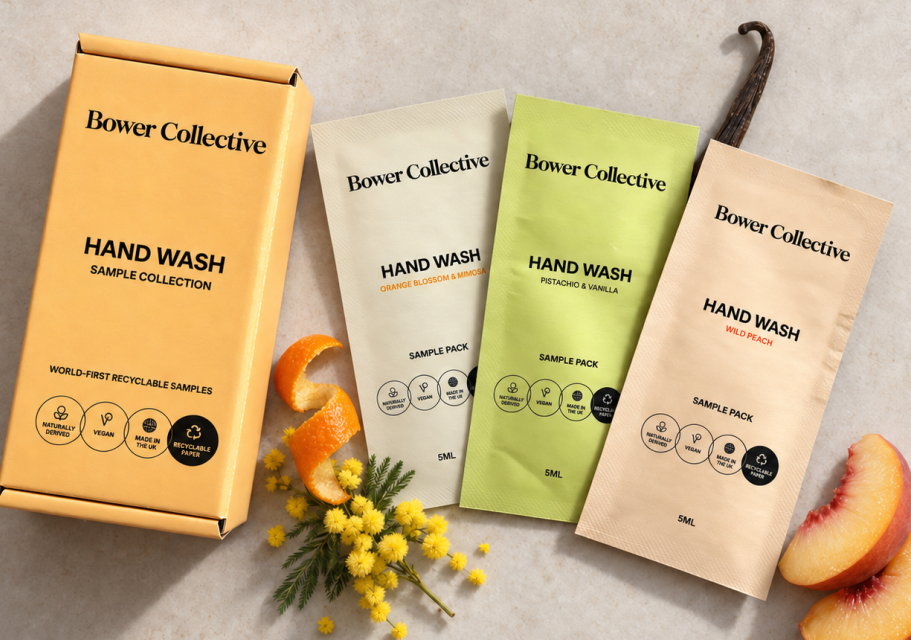
The coated paper has now been used to produce sachets for Bower Collective, the sustainable home and personal care brand. The companies announced the launch in September 2026, describing it as a world-first paper sachet containing a liquid product using a fossil fuel plastic-free, recyclable format.
For Guardpack, the significance lies not only in the material itself, but in demonstrating that it can be manufactured using existing sachet-filling equipment.
That production-line compatibility is an important consideration when developing sustainable sachet packaging. New materials need to balance environmental objectives with the practical requirements of commercial manufacturing, including compatibility with existing equipment, sealing, filling and product protection.
The Wider Move Towards More Sustainable Sachets
Sachets can be particularly challenging to redesign because they need to provide a reliable barrier against liquids while remaining lightweight and suitable for efficient production. Traditional formats can use multi-layer or foil-laminate constructions, which can make recycling more difficult.
As PPWR recyclability requirements tighten towards 2030, Guardpack is actively evaluating a range of packaging options, including seaweed-derived and kerbside-recyclable paper substrates as potential next-generation alternatives to traditional foil-laminate sachets.
Guardpack’s early-stage work with innovators such as Kelpi is highlighting a genuine opportunity to move packaging towards mono-material, recyclable formats while maintaining the barrier performance that liquid-filled products depend on. The work forms part of our wider exploration of emerging materials and their ability to deliver the performance required in real-world manufacturing environments. Read more on our Environmental & Corporate Responsibility page.
What Comes Next for Sustainable Sachet Packaging?
The latest production run represents another step in Guardpack’s ongoing work to understand how new materials can be integrated into sachet manufacturing. Further validation will be important, particularly when assessing different liquid formulations and their required shelf life. However, successfully moving from an initial trial to production provides valuable insight into what is possible and where further development may be required.
As the packaging industry continues to look for alternatives to traditional plastic-based formats, collaboration between material innovators and experienced manufacturers will be increasingly important.
For Guardpack, sustainable sachet packaging is not simply about finding a new material, but finding solutions that can combine improved environmental credentials with the reliability, performance and manufacturing practicality that liquid-filled products require.
Contact Us
For more information on our plastic free wipes and sustainable packaging, get in touch with us today. Simply fill out our contact form, email us at trade@guardpack.co.uk, or speak to one of the team today on 01245 505807. We look forward to hearing from you.